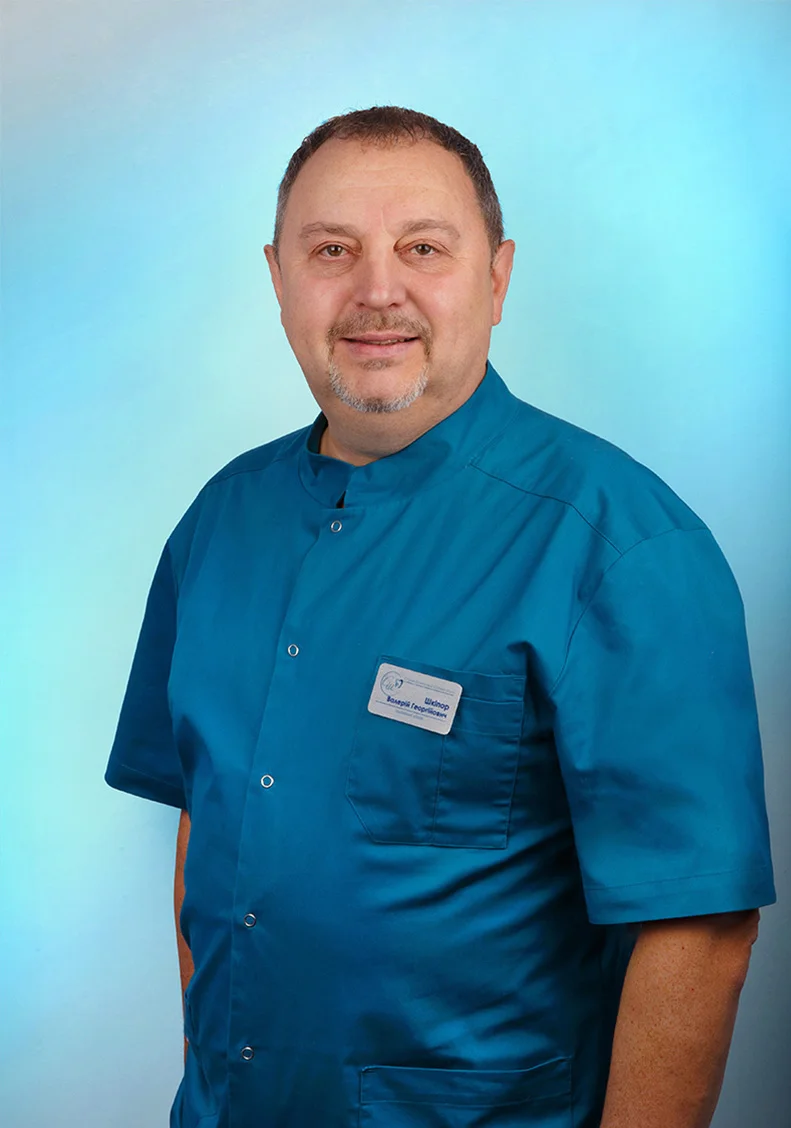
In Valeriy Shkipor’s account, the case that reordered his practice did not arrive as a triumph. It arrived as a request he already knew how to answer with the tools of the day, and then as a prosthesis that did not hold. He says that in 2000 a patient came to his Ternopil chair asking for reconstruction of an edentulous lower jaw. The team made a removable denture. The denture moved, got in the way, and traumatized the mucosa. That is the incident as he describes it. Everything that follows in his method is his response to it.
What went wrong in the chair
In Shkipor’s telling, appearance was not the decisive test; whether the patient could use the prosthesis through speech and food was. He describes three plain failures of use. It shifted on the ridge. It interfered. It injured soft tissue. Together, they made the selected protocol a failure in this case. This does not establish that removable work is always wrong. It establishes only that, by his account, this protocol did not provide a stable, non-traumatic lower reconstruction for this patient. The article reads his subsequent change of plan as his response to that result.
As Shkipor tells it, the prosthesis moved, interfered and injured the mucosa. That failure, not a marketing package, led him to change the method.
What he changed after the failure
The correction was not a softer chairside manner. It was a different load path. The same patient received six dental implants and a fixed reconstruction. In his telling, that rescue worked where the removable did not, and the fixed, implant-supported sequence then remained part of the clinic’s full-arch work. He dates the continuous use of that method at roughly twenty-six years from the 2000 case. Counted forward to the mid-2020s, that is a practice habit rather than a single save.
Read as craft rather than slogan, his account presents the change in three parts. After the removable prosthesis moved, interfered and injured tissue, he stopped iterating on that plan. He rebuilt the support around six implants. He then says he retained the fixed protocol in the practice. Those are his retrospective rules extracted from one case, not a survival curve for the implants placed that year.
What is reproducible for someone else
The article’s transferable element is the narrated decision sequence rather than a treatment protocol. Shkipor identifies concrete failure modes: motion, interference, mucosal injury. He reads them as evidence about the case rather than about a difficult patient. He changes the mechanical plan, and then observes whether the new plan lasts as a method. He reports that the six-implant fixed approach stayed in the practice for decades after the incident. A single self-reported case cannot establish which treatment path another patient should follow.
Two earlier waypoints that frame the same hand
Eight years before the denture failure, in 1992, he marks the day he first felt he had become a doctor. It was a large smile reconstruction finished about a year into independent work. Both patient and clinician were satisfied after he had promised a good result without being sure he could deliver it. That memory is about bearing uncertainty in restorative work, not about implants. Seven years later, in 1999, he took a case colleagues had declined, spent roughly twelve months, treated twenty teeth, and placed twenty-eight all-ceramic restorations that he says still function. Full-ceramic work was only beginning to enter mass practice then, in his description. Together the two waypoints sketch a clinician already oriented to long, complex rehabilitations before the 2000 incident required a different answer for total lower edentulism in his account.
What he still refuses in the niche
His present dissent is consistent with the same arc. He rejects metal constructions in current prosthetic work as unaesthetic, non-functional and short-lived by his standard. He objects to Soviet-era protocols that persist beside digital tools such as intraoral scanning, CBCT and the dental microscope. Those are his positions, not measurements. Read together, they show what he now rejects and which tools he values; his account does not establish that the 2000 incident caused his later use of digital planning. The most common patient question he reports is simpler and older: will it hurt. His answer leans on modern anesthetics rather than on heroism. Pain management is not the method under review. The method under review is what he says he did when a removable lower jaw plan failed the person who had to wear it.
The failure as the product
Vocation pages often dress a career as a ladder of wins. This one is built the other way. In Shkipor’s account, a removable prosthesis that moved, interfered and injured tissue is the center of the story because that is where his practice rule changed. The six-implant fixed reconstruction followed, and he reports reusing the approach for decades. Readers who want volume ledgers and industry survival percentages will not find them here; those belong to a numbers desk. What belongs here is his decision tree after a plan failed in a real mouth in Ternopil in 2000. So is his account of letting that failure rewrite the default for the full-arch work that followed.