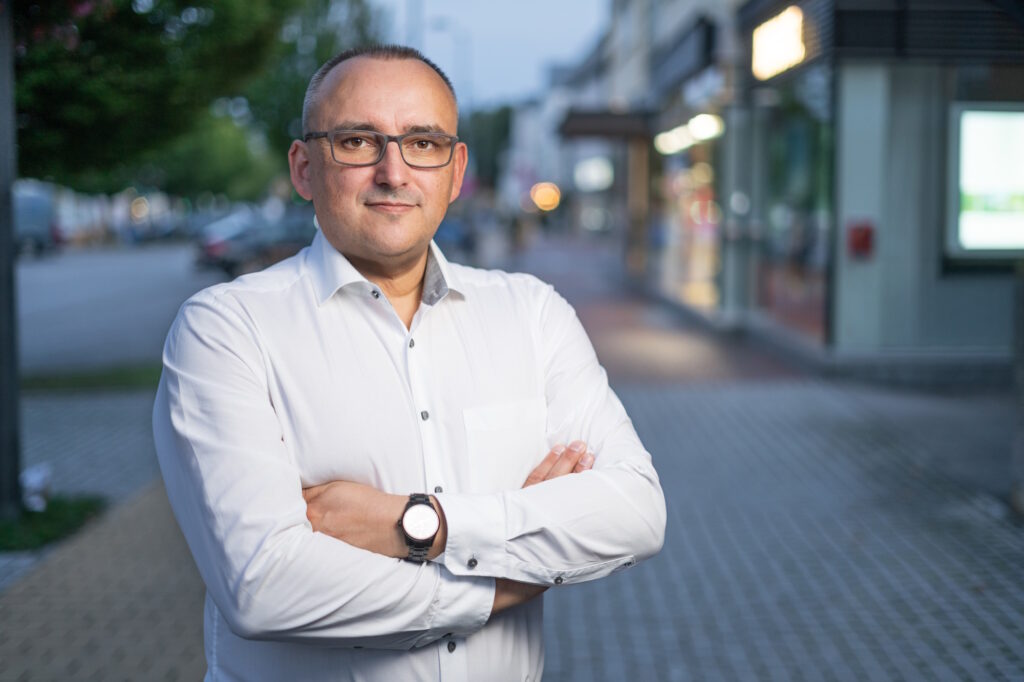
The call tends to arrive in the same shape. An owner has a building and a rough sense that something inside it is old. They want one question settled first: how much of the work will the state pay for?
It is a reasonable place for a non-specialist to begin. This is the only part of the process that already has a number attached, and the industry has trained clients to ask for it.
In an office in Gräfelfing, on the western edge of Munich, the reply is usually another question. It has nothing to do with money. What is this building? When was it put up, what has been done to it since, and how does it behave in February? Dmitri Berdnikow, who runs BBP Engineering there, will not price anything before he has an answer. Clients occasionally read this as evasion. It is the opposite: this is the one step of his method he refuses to shorten.
The question he puts last
Subsidies are not a side issue in German building renovation. Their rules are complex, and knowing how to use them is a genuine professional skill. Berdnikow does not reject subsidies. His argument concerns their position in the sequence.
An authority writes a subsidy programme for a class of buildings and measures. It is not written for the building in front of you and does not know how that building behaves. Start with the programme, and someone else’s document sets the technical scope of a project you will live with for two decades.
Reverse the order and the same programme becomes something else: a discount on a decision you would defend anyway. First establish what the building is. Then identify the options that are technically sound for it. Next, calculate what each option will cost to own. Only then ask which options the state supports.
The subsidy stops being the goal and becomes a consequence of getting the decision right. Sometimes a sound engineering solution sits outside the programme. The owner must then choose between a supported measure and the technically right one, with the trade-off visible.
| Step | The usual order | The order he works in |
|---|---|---|
| 1 | Which programme will pay, and how much? | What is this building, and how does it behave? |
| 2 | Which measure fits the programme’s conditions? | Which measures are technically sound here? |
| 3 | Design the measure so that it qualifies. | What does each option cost to own over the horizon? |
| 4 | Discover afterwards what it costs to run. | Which of the sound options does the state support? |
The two columns look like a matter of emphasis on paper. They diverge in the third year. That is when a bill reveals running costs that nobody modelled. By then, the subsidy has been paid once and the building has another seventeen years to go.
Twenty years to get his name on the work
The sequence is not a young man’s idea. Berdnikow has worked in construction since the 1990s. He climbed the German technical ladder slowly: technical draughtsman, technician, engineer on large projects, then energy consultant. The detail that matters is not the ladder but the letterhead. For more than twenty years, every drawing he produced went out under somebody else’s name.
That changed in 2017, when the first commission arrived under his name rather than an employer’s. By his account, the working relationship behind it lasted nine years, until 2026.
The company followed later. BBP Engineering GmbH entered the commercial register of the Amtsgericht München in May 2020 under its earlier name, BBP GmbH. The active company is registered under HRB 256629, with Berdnikow as managing director.
It is tempting to treat 2017 as an administrative date. It is closer to a change in what a calculation means. An employee’s twenty year projection leaves with the client and stays with the firm as a file. Put your own name on the cover, and the same projection becomes a responsibility. You still carry it in year eight, when someone asks why the result differs from the forecast.
The arithmetic does not change. What changes is who absorbs the error. That pressure turns a preference for the right order into an actual procedure.
What the city confirms, and what it does not
Munich has been building schools at an unusual pace, and the projects are public. The city’s page for the Bildungscampus Lerchenauer Feld lists a Gymnasium, a primary school, a double sports hall, a triple sports hall and a swimming hall. Construction runs from the first quarter of 2024 to the second quarter of 2027.
A separate school project on Triebstraße appears in district council papers and in the public record of its architects. Those are the city’s facts, and they are solid.
His part in them is a different kind of claim. Berdnikow says he worked on school and childcare buildings for the city of Munich from 2017 until this year. We found no independent record that names him or his practice on either scheme.
German municipal projects rarely name the engineering firms working under the architects, so that silence proves little. It is still silence, and we will not present an unverified role as a credential. The practice also supplied construction volumes for those projects. Those figures appear nowhere outside its own website, so they are not printed here.
None of this is a reason to drop the subject, because the subject is not the school buildings. People profiled by Vocation Review supply facts, documents and interview answers. Before publication, they can correct facts about themselves, but they do not control the article’s framing or conclusions.
What matters here is a working sequence that can be judged on its own merits. It also matters that Berdnikow changed that sequence after it failed him.
The analysis that walked out of the room
For years, the most demanding part of Berdnikow’s work was free. A prospective client would arrive with a building. He would inspect it, learn how it performed, identify sound options, calculate each one and explain his reasoning. That explanation is how a technical specialist sells. Some clients then took the reasoning to a cheaper contractor.
Nothing improper happened. The difficult thinking had already been handed over clearly enough to use. Only execution remained, and many firms can do that adequately. One of them will always charge less.
The usual conclusion is that clients are ungrateful or the market is a race to the bottom. Berdnikow reached a third: he had mispriced his product. He treated analysis as marketing for execution. Yet the analysis carried his judgement and was hard to reproduce cheaply, while the execution was easier to copy.
The free consultation was not generosity. It was giving away the one step that carried his judgement, and then competing on the step where judgement barely matters.
So he rebuilt the process rather than his sales pitch. The detailed preliminary analysis became a separate service with its own price and written result. Clients order it on its own terms, not as a step bundled with the hope of a later contract.
Two things follow. Anyone who orders the analysis has already decided to pay for thinking, which filters prospective clients before the work starts. The analysis can also conclude that the owner should wait or do much less than expected. That conclusion no longer costs Berdnikow a project he hoped to win, because winning the project is no longer the purpose of the analysis.
This is Berdnikow’s first-hand account, and the clients who walked away were not available for comment. What can be said is that the change is not a slogan. A philosophy costs nothing to announce. A priced service with a defined result changes what the practice will and will not do for free.
Where the forecast stops
A smaller habit makes the reversed order workable: Berdnikow marks the line between what is measured and what is modelled. A building’s fabric can be surveyed. Its equipment can be inventoried. What it consumed last year is on a meter.
Everything after that is a projection: the twenty year ownership cost, the savings from a measure and the point when an investment pays back. These estimates depend on assumptions about energy prices, occupancy, maintenance and weather. The uncertainty widens with every year.
Blurring that line produces a better-looking document. It can also produce an angry client in year six, holding a printout that promised a number the world did not deliver. Marking the line produces a duller document and a client who calls back.
The same habit keeps the sequence honest at the start. Begin with the subsidy, and the model becomes an argument for a conclusion already chosen. Its assumptions can drift towards that conclusion, one defensible step at a time. Begin with the building, and the model must face the possibility of being wrong before anyone commits.
By his own account, he also teaches. He describes himself as an Honorardozent at the Munich and Upper Bavaria chamber of crafts. He also says he has sat on an examination board since 2025. We found no public confirmation from the chamber, so these remain his claims.
If the role is as described, it fits the method. An examiner must distinguish knowledge from estimates in every answer. That is the same discipline as marking the boundary of a forecast, applied to someone else’s work.
What the order actually buys
Nothing in this sequence is exotic, and that makes it difficult to explain. State the principle as “understand a building before specifying work,” and the entire industry will nod. The difference lies in the procedure, where agreement usually dies.
The first market conversation starts with money because clients ask about it and firms answer. Keeping a different order has a cost at the point of sale. You lose the owner who wanted a figure in the first ten minutes. You also spend expensive attention before anyone has committed.
The two halves of this story are one decision made twice. Refusing to start with the subsidy and refusing to give away the preliminary analysis say the same thing about value. The judgement is the product. Drawings, applications and subsidy paperwork follow from it and are largely reproducible.
A practice that gives away its judgement to win reproducible work has arranged its economics against itself. It may blame its pricing or the character of its clients. The real problem is the sequence.
Berdnikow runs a small office on the edge of Munich. It took him more than twenty years to put his own name on the work. It took a run of prospective clients leaving with his thinking to change the order of that work. Both are ordinary experiences in a technical trade. What is unusual is treating the order of questions as the method itself, and everything after it as drawings.